
Waveguide Dual Directional Coupler | Loop Coupler for 2.45GHz Industrial Microwave
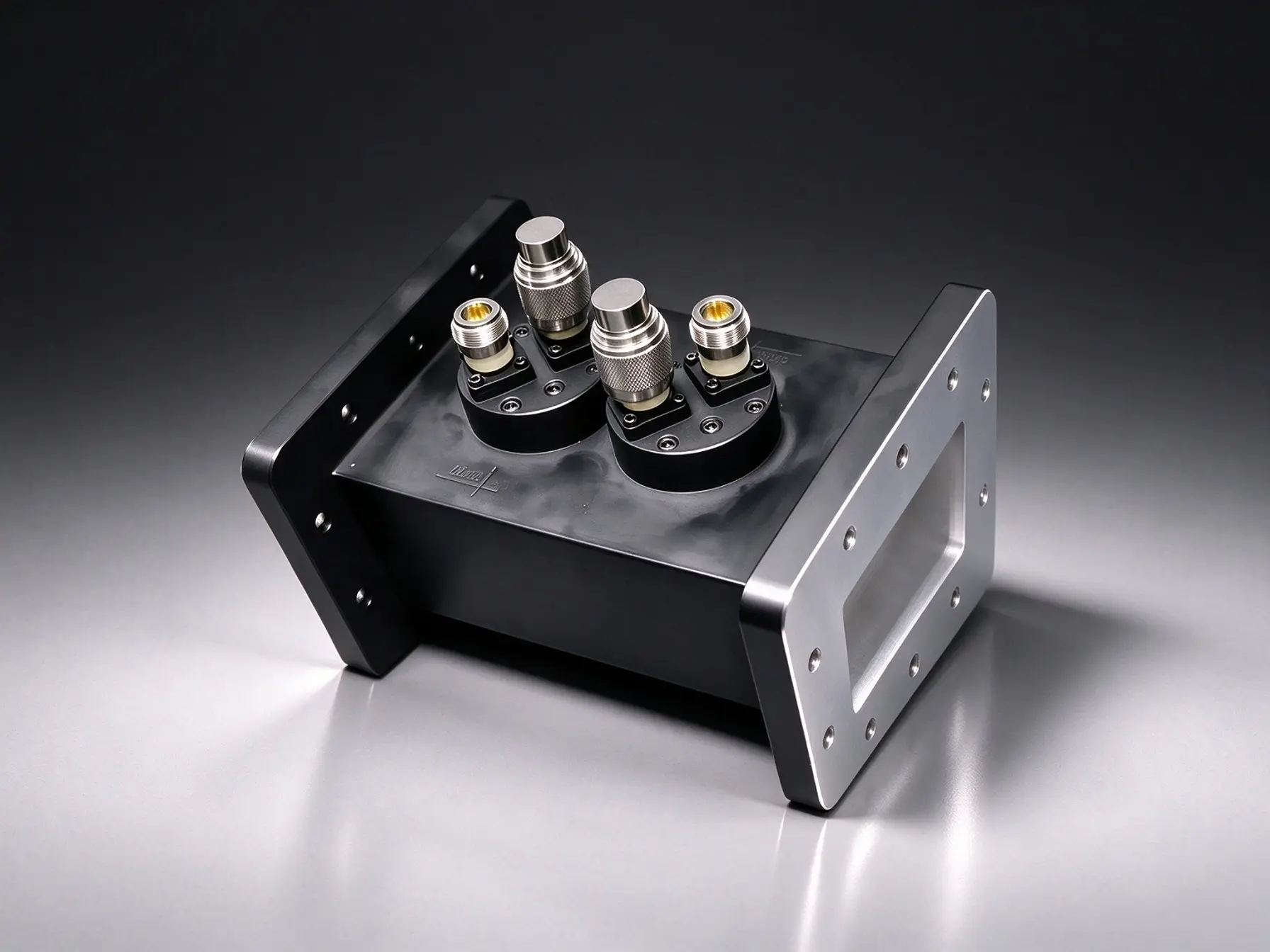
Waveguide transmission structures are widely adopted in 2.45GHz industrial microwave systems, including magnetron heating, microwave drying, thawing and plasma generators. The unit shown in the photo is a waveguide loop-type dual directional coupler. It integrates two N-type coaxial sampling ports for forward and reflected power, used for real-time VSWR protection and power monitoring. Let’s discuss the difference between loop couplers and aperture couplers for industrial microwave applications.
2450MHz is the most common frequency for industrial microwave worldwide. When engineers select power sampling components for waveguide runs, they usually face two mainstream designs: magnetic loop coupler (this model) and crossguide aperture coupler.
✅ Key Advantages of Loop Directional Coupler for High Power
- High power handling and low arcing risk
The loop samples magnetic field inside the waveguide. Unlike crossguide couplers, it does not require coupling apertures on the broad wall, which avoids sharp edges where electric field tends to concentrate. Under high power at 2450MHz, electric field concentration is the main cause of arcing. The loop structure greatly reduces arcing probability and delivers better stability for continuous-running high-power magnetron systems. - Customizable coupling value
Coupling level can be tuned for 2450MHz, standard range from 20dB to 60dB. N-female output ports are compatible with power detectors, meters and PLC modules for easy integration. - Integrated forward and reflected power sampling in one housing
Both forward and reflected power sampling are combined in one housing. You do not need two separate couplers on the main waveguide line. Fewer flanges mean lower VSWR degradation and simpler cabinet layout.
⚠️ Limitations of Loop Coupler you need to consider
- Narrow bandwidth
Loop couplers are narrowband components optimized for fixed single frequency (2450MHz). It is not suitable for swept-frequency or wideband applications. Crossguide aperture coupler is the better choice for broadband needs. - Lower directivity compared with precision aperture couplers
Crossguide couplers can reach directivity above 30dB, while loop couplers have relatively lower directivity. It is not ideal for metrology-grade, high-precision power measurement. - Strict requirement on machining & tuning
Coupling and directivity are very sensitive to the position, height and angle of the inner loop. Precision assembly and tuning are mandatory to guarantee consistent performance.
📌 Quick Selection Guide @ 2.45GHz
👉 Choose Loop Directional Coupler for:
Industrial magnetron microwave machines, drying / sterilization / thawing lines, fixed 2450MHz operation, continuous high power, top priority on anti-arcing and reliable VSWR protection.
👉 Choose Crossguide Aperture Directional Coupler for:
RF lab test benches, wideband signal sources, applications requiring high directivity and accurate measurement, low to medium power level.
From communication with global buyers, we noticed a typical difference in selection logic:
Many engineers check directivity data first; while senior industrial microwave designers tend to focus on power rating, continuous running reliability and arcing history.
Here are discussion questions for microwave engineers:
When you design 2.45GHz microwave systems, what is your priority list for directional coupler selection?
Directivity & coupling flatness, or power capacity, anti-arcing performance and long-term stability?
Have you encountered arcing issues with high-directivity aperture couplers under high power? Or solved persistent VSWR false alarm problems after switching to loop couplers?
Leave your comments and share your experience.
This article is for technical discussion only. Final selection of the coupler shall be validated against average power, peak power, operating frequency, alarm threshold and sealing requirements.